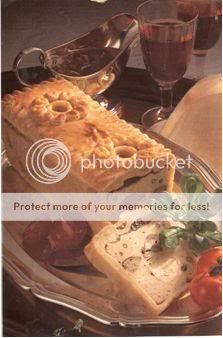
Fleischpasteten ("Pies") Grundrezept
Teig für eine 18-cm-Springform
350 g Mehl
1/4 Tl Salz
100 g Butter
150 ml Wasser oder Milch
1 Eigelb (optional)
1 Eiweiß zum Bestreichen
Wasser und Butter in einen Topf und erhitzen, bis die Butter geschmolzen ist. Vom Feuer 'runter-, nehmen, Mehl hineinsieben, gut verrühren (einschl. Eigelb). Wenn der Teig soweit abgekühlt ist, dass man ihn anfassen kann, durchkneten bis er weich ist. Auf einem leicht bemehlten Untergrund ausrollen wie gewünscht. Den nicht sofort benötigten Teig (z.B. für den Deckel der Pastete und die Dekorationen) derweil warm halten. Form leicht fetten und mit Paniermehl bestäuben.
Man sollte die Pastete, wenn sie ganz abgekühlt ist, mit einer Gelatine aus Brühe und (wenn man mag) Alkohol (z.B. Sherry, Portwein etc.) ausgießen, sozusagen zur "Hohlraumversiegelung", dann bleibt sie saftiger. Am besten am Vortag zubereiten, damit sie ganz auskühlen kann.
Fleischpastete (Melton Mowbray Pork Pie)
Rezept für eine 18-cm-Springform
675 g mageres Schweinefleisch ohne Knochen
225 g fetter Schweinebauch ohne Knochen, Schwarte etc.
6 bis 8 Anchovisfilets
3 El helle Brühe
Salz, Pfeffer aus der Mühle
Beide Fleischsorten fein Würfeln oder grob moulinettieren und zusammenmischen. Anchovis fein hacken und mit der Brühe dazumischen, mit Salz (Vorsicht, Anchovis sind salzig!) und reichlich Pfeffer abschmecken, stehen lassen während der Zubereitung des Teiges (s.o.). In den Deckel der Form ein Loch machen (evtl. auch einen "Kamin" aus Alufolie), alle Ränder gut verkleben, mit Eiweiß bestreichen.
Ofen auf 160°C vorheizen. Während des Backens evtl. entstehende Flüssigkeit zwischendurch abgießen. 2 1/2 Stunden backen, falls zu braun, abdecken.
Kalbs-, Schinken- und Geflügelpastete (Veal, Ham and Chicken Pie)
Rezept für eine 18-cm-Springform
Alles wie oben, aber für die Füllung etwa 600-700 g dünn geschnittenes rohes Geflügelfleisch in Schichten mit der Masse, die für "Eingemachtes" Kalbfleisch mit Schinken (s.u.) angegeben wird anordnen. Backen wie oben.
"Eingemachtes" Kalbfleisch mit Schinken
Für mehrere kleine Gefäße (z.B. Ragout-Fin-Förmchen)
350 g rohes Kalbfleisch
225 g gekochter Schinken
100 g Bacon-Streifen
50 g Butter
1 gute Prise Muskatblüte
4 Esslöffel Kalbsbrühe
2 Esslöffel trockener Sherry
Salz und frisch gemahlener Pfeffer
75 g geklärte Butter
Kalbfleisch, Schinken und Bacon zweimal durch den Fleischwolf drehen oder fein moulinettieren. Die 50 g Butter schmelzen und und mit dem Fleisch und den Gewürzen vermischen.
In mehrere kleine Förmchen füllen, mit Folie abdecken und in eine Fettpfanne mit heißem Wasser (etwa bis zur Hälfte der Höhe der Förmchen) stellen. den Ofen auf 160°C vorheizen und 1 1/4 Stunden lang kochen lassen. Auskühlen lassen, dann mit geschmolzener, geklärter Butter abdecken.
Die Rezepte der Editrix und ihre kulturübergreifenden Beobachtungen
Vorsicht: Sozialwissenschaftliche Kommentare, viel Fleisch, Fett, Zucker, Alkohol und überhaupt voll von ungesundem und lebenverkürzendem (aber
-verschönerndem) Zeug!
Beware: Social commentary, lots of meat, fat, sugar, alcohol and generally
full of unhealthy and life-shortening (albeit -brightening) stuff!
Showing posts with label Pies/Fleischpasteten. Show all posts
It's Bilbo and Frodo's Birthday!
From The Sage from Texas:
While the birthday of two such estimable hobbits is, in and of itself, more than sufficient cause for a celebration, this is a day to celebrate so much more: Middle Earth, the Nobility of Aragorn, the Wisdom of Gandalf, the Courage of Sam, the Shire itself---in short, all that is at the heart of what we call normal and decent. The stories of Bilbo and Frodo provide a lifeline for us to a dimension where morality still exists, where Truth is honored, where virtue, it’s own reward, is nevertheless rewarded. While we’re at it, we may drink a toast to Tolkien himself, and to Lewis and Williams and Barfield and all the other sparkling intellects who gathered at the Eagle and Child. We may drink a toast to Narnia, and hope for the day when we can enter Aslan’s Country, for which we are all, at heart, truly homesick. We can drink a toast to George McDonald, and the Brothers Grimm, and all those who, in the exquisite code of a besieged but determined underground have encouraged and reminded us of Our King and His Reward, which may only be obtained on careful condition and after much danger in the enchanted forest.
For this most merry feast, let us enjoy:
Buckland Pie
1 unbaked 12 inch pie shell
10 strips bacon, diced
2 medium onions, chopped
3 large eggs
¾ cup cream
8 oz baby portobellos, roughly chopped
8 oz white mushrooms, chopped
(you may substitute a pound of whatever mushrooms you can get)
¼ teaspoon white pepper
1 cup cheddar cheese
Sauté the bacon until nearly done, then add the onions. When onions are transparent, add mushrooms and saute just a little. Put about half the cheese in the bottom of the pie shell. Pile on the sauted ingredients with a slotted spoon, leaving the bacon grease behind. Put the grease on the dog’s foodit has onions in it and shouldn’t go into the bacon grease jar, but the dog will benefit greatly. Sprinkle the remaining cheese over the top. Beat the eggs lightly and add the cream and white pepper. Carefully pour over the other ingredients---if it won’t quite fit, give the leftovers to the dog.
Put the pie on a baking sheet and transfer to a 350 degree oven. Bake until setabout 25 minutes or so. Serve with baby spinach salad with a light dressing and wash down with good beer. One pie will not feed more than four---it is just too good.
While the birthday of two such estimable hobbits is, in and of itself, more than sufficient cause for a celebration, this is a day to celebrate so much more: Middle Earth, the Nobility of Aragorn, the Wisdom of Gandalf, the Courage of Sam, the Shire itself---in short, all that is at the heart of what we call normal and decent. The stories of Bilbo and Frodo provide a lifeline for us to a dimension where morality still exists, where Truth is honored, where virtue, it’s own reward, is nevertheless rewarded. While we’re at it, we may drink a toast to Tolkien himself, and to Lewis and Williams and Barfield and all the other sparkling intellects who gathered at the Eagle and Child. We may drink a toast to Narnia, and hope for the day when we can enter Aslan’s Country, for which we are all, at heart, truly homesick. We can drink a toast to George McDonald, and the Brothers Grimm, and all those who, in the exquisite code of a besieged but determined underground have encouraged and reminded us of Our King and His Reward, which may only be obtained on careful condition and after much danger in the enchanted forest.
For this most merry feast, let us enjoy:
Buckland Pie
1 unbaked 12 inch pie shell
10 strips bacon, diced
2 medium onions, chopped
3 large eggs
¾ cup cream
8 oz baby portobellos, roughly chopped
8 oz white mushrooms, chopped
(you may substitute a pound of whatever mushrooms you can get)
¼ teaspoon white pepper
1 cup cheddar cheese
Sauté the bacon until nearly done, then add the onions. When onions are transparent, add mushrooms and saute just a little. Put about half the cheese in the bottom of the pie shell. Pile on the sauted ingredients with a slotted spoon, leaving the bacon grease behind. Put the grease on the dog’s foodit has onions in it and shouldn’t go into the bacon grease jar, but the dog will benefit greatly. Sprinkle the remaining cheese over the top. Beat the eggs lightly and add the cream and white pepper. Carefully pour over the other ingredients---if it won’t quite fit, give the leftovers to the dog.
Put the pie on a baking sheet and transfer to a 350 degree oven. Bake until setabout 25 minutes or so. Serve with baby spinach salad with a light dressing and wash down with good beer. One pie will not feed more than four---it is just too good.
Raised Pies
HOT WATER CRUST PASTRY
Cooking time: as specific recipes
This pastry is made by melting the fat in the water, then adding the flour. It is ideal for cold savory pies. The pastry must be kept warm during rolling and shaping to prevent it breaking. lt is also known as raised pie pastry.
350 g plain flour
1/4 tsp salt
100 g lard or cooking fat
150 ml milk or water
Sift the flour and salt into a mixing bowl. Put the lard or cooking fat into a saucepan with the milk or water and heat until melted. Remove the pan from the heat then add all the flour to the hot mixture, stir well until blended. Allow the dough to cool slightly, so it can be handled, then knead until smooth. Placethe portion required for the base and sides of a pie on a lightly floured board and roll out to desired shape. Keep the rest ofthe pastry, which may be needed for the lid of a pie, in a warm place. Shape and bake as specific recipes.
Variation:
You can add an egg yolk for extra flavour without affecting the amount of liquid.
VEAL AND HAM PIE
Cooking time: 2 1/2 hours • Serves 6
To make the Veal and Ham Pie follow the hot water crust pastry recipe.
For the filling use a total of 900 g veal and ham - this can be equal quantities of each meat or 675 g of veal and 225 g cooked ham. The meats should be diced and mixed together. The method of filling then baking the pie is as given for the Melton Mowbray Pork Pie but omit the anchovy fillets. The stock can be flavoured with a little finely grated lemon zest. It is usual to hard-boil 2 to 4 eggs and put these in the centre of the meat.
When cold, the pie is filled with a jellied stock.
VEAL, HAM AND CHICKEN PIE
Another less usual version of this pie is made by using approximately 675 g thinly sliced uncooked chicken flesh and layering this with the mixture given for Veal and Ham Pie. Bake as the Melton Mowbray Pork Pie.
MELTON MOWBRAY PORK PIE
Cooking time: 2 1/2 hours • Serves 6
This pie it is said to have been invented by a baker in Melton Mowbray, Leicestershire, in 1830. The inclusion of anchovy fillets with pork is unusual but quite good.
625 g lean boneless pork from the leg
225 g fat boneless pork from the belly
6 to 8 anchovy fillets
3 tbspoons white stock
Salt and freshly ground black pepper
Hot water crust pasty from 350 g flour (see above)
1 egg to glaze the pastry
For the jelly:
150 ml white stock
1 teaspoon gelatine
Dice both kinds of pork and blend together. Chop the anchovy fillets and mix with the meat, add the stock. Allow to stand while making the pastry. Season with very little, if any, salt but with pepper. Make the hot water crust pastry as above.
Pre-heat the oven to 160°C/325°F, Gas Mark 3. Lightly grease an 18 cm/7 inch round tin with a loose base or a proper raised pie springform tin, which is usually oval. Roll out two-thirds of the dough (keep the rest warm). Cut a shape to fit the base ofthe tin, and a band the depth and circumference of the sides. Insert the pastry in the tin, moisten and seal the edges. Moisten the top edges of the pastry.
Put in the filling. Roll out the remaining pastry and cut out the lid. Place over the filling and seal the edges. Beat the egg and brush over the pastry.
Traditionally this kind of pie is decorated with pastry leaves and a rose or tassel, so make these from the left-over pastry. Make a slit in the centre of the pastry lid for the steam to escape. Press the leaves and rose or tassel on top of the pie, brush with egg.
Bake for 2 1/2 hours. Lower the heat slightly after 2 hours, if the pastry is becoming too brown. Allow the pie to become quite cold.
Pour the 150 ml stock into a basin, add the gelatine, stand for 2 to 3 minutes then dissolve over hot water. Cool until like a thick syrup. Insert a small funnel into the slit in the pastry lid and pour the jelly through this. Leave the pie in the refrigerator for several hours for the jelly to set, then serve cold with salad.
(I got this from: Marguerite Patten: Classic British Dishes.)
Cooking time: as specific recipes
This pastry is made by melting the fat in the water, then adding the flour. It is ideal for cold savory pies. The pastry must be kept warm during rolling and shaping to prevent it breaking. lt is also known as raised pie pastry.
350 g plain flour
1/4 tsp salt
100 g lard or cooking fat
150 ml milk or water
Sift the flour and salt into a mixing bowl. Put the lard or cooking fat into a saucepan with the milk or water and heat until melted. Remove the pan from the heat then add all the flour to the hot mixture, stir well until blended. Allow the dough to cool slightly, so it can be handled, then knead until smooth. Placethe portion required for the base and sides of a pie on a lightly floured board and roll out to desired shape. Keep the rest ofthe pastry, which may be needed for the lid of a pie, in a warm place. Shape and bake as specific recipes.
Variation:
You can add an egg yolk for extra flavour without affecting the amount of liquid.
VEAL AND HAM PIE
Cooking time: 2 1/2 hours • Serves 6
To make the Veal and Ham Pie follow the hot water crust pastry recipe.
For the filling use a total of 900 g veal and ham - this can be equal quantities of each meat or 675 g of veal and 225 g cooked ham. The meats should be diced and mixed together. The method of filling then baking the pie is as given for the Melton Mowbray Pork Pie but omit the anchovy fillets. The stock can be flavoured with a little finely grated lemon zest. It is usual to hard-boil 2 to 4 eggs and put these in the centre of the meat.
When cold, the pie is filled with a jellied stock.
VEAL, HAM AND CHICKEN PIE
Another less usual version of this pie is made by using approximately 675 g thinly sliced uncooked chicken flesh and layering this with the mixture given for Veal and Ham Pie. Bake as the Melton Mowbray Pork Pie.
MELTON MOWBRAY PORK PIE
Cooking time: 2 1/2 hours • Serves 6
This pie it is said to have been invented by a baker in Melton Mowbray, Leicestershire, in 1830. The inclusion of anchovy fillets with pork is unusual but quite good.
625 g lean boneless pork from the leg
225 g fat boneless pork from the belly
6 to 8 anchovy fillets
3 tbspoons white stock
Salt and freshly ground black pepper
Hot water crust pasty from 350 g flour (see above)
1 egg to glaze the pastry
For the jelly:
150 ml white stock
1 teaspoon gelatine
Dice both kinds of pork and blend together. Chop the anchovy fillets and mix with the meat, add the stock. Allow to stand while making the pastry. Season with very little, if any, salt but with pepper. Make the hot water crust pastry as above.
Pre-heat the oven to 160°C/325°F, Gas Mark 3. Lightly grease an 18 cm/7 inch round tin with a loose base or a proper raised pie springform tin, which is usually oval. Roll out two-thirds of the dough (keep the rest warm). Cut a shape to fit the base ofthe tin, and a band the depth and circumference of the sides. Insert the pastry in the tin, moisten and seal the edges. Moisten the top edges of the pastry.
Put in the filling. Roll out the remaining pastry and cut out the lid. Place over the filling and seal the edges. Beat the egg and brush over the pastry.
Traditionally this kind of pie is decorated with pastry leaves and a rose or tassel, so make these from the left-over pastry. Make a slit in the centre of the pastry lid for the steam to escape. Press the leaves and rose or tassel on top of the pie, brush with egg.
Bake for 2 1/2 hours. Lower the heat slightly after 2 hours, if the pastry is becoming too brown. Allow the pie to become quite cold.
Pour the 150 ml stock into a basin, add the gelatine, stand for 2 to 3 minutes then dissolve over hot water. Cool until like a thick syrup. Insert a small funnel into the slit in the pastry lid and pour the jelly through this. Leave the pie in the refrigerator for several hours for the jelly to set, then serve cold with salad.
(I got this from: Marguerite Patten: Classic British Dishes.)
Glazed Chicken or Turkey Pie
I never know how to translate the German "Pastete" because it certainly isn't anything like the English "pie", so I have settled for "glazed pie". To give you a hint: The result ought to look somewhat like this:
Okay, here it goes:
Ingredients for a 1.5 litre rectangular tin (a tin with folding-down sides is advisable):
For the dough (or is it pastry? I'll stick to dough, although it MAY be pastry.):
500 g plain flour
150 g lard
50 g butter, salt, one egg yolk
For the filling:
350 g chicken or turkey
400 g pork belly
Salt, 1 tsp white pepper
1/2 tsp macis (or to taste)
300 g chicken or turkey liver
2 tbsp Butter
300 g chicken- or turkey breast fillet
100 g cream
2 cl Madeira
3 tbs green peppercorns
1 tsp pimento (allspice)
A large pinch of cayenne pepper
grated lemon peel from 1 lemon
For the glaze:
1 egg yolk, 1-2 tsp cream
For the jelly
3 leafs of gelantine
200 mg stock
100 ml Port
Flour for rolling out the dough
Fat to grease the baking tin
Time to make: About 2 hours
Cooling time: 12 hours
Method:
1. Knead the ingredients for the dough quickly together together with 100-150 ml cold water, put in a cold place.
2. For the filling dice chicken or turkey meat and pork's belly and put through a mincer twice or mince thoroughly in a food processor. Season generously with salt, pepper and macis and blend throughly. Put in a cold place.
3. Remove the sinews from the liver. Heat the butter and brown liver lightly. Drain (let drip off) on kitchen roll, season with salt and pepper. Brown the chicken- or turkey breast fillets. Blend the (in the meantime cooled) forcemeat with cream, Madeira, green pepper corns and ground lemon peel, season generously. Pre-heat the oven to 220° C.
4. Roll out the dough about 4 mm thick in a rectangular shape. Mark the outline of a baking tin and cut out. Grease the baking tin and line with the dough. Roll out the remaining dough about 1/2 cm thick and cut out in the shape of a top. Leave a little bit dough for ornaments.
5. Fill a third of the forcemeat into the baking tin, place the fillets in the middle and cover with a thin layer of forcemeat. Do the same with the livers and cover with the remaining forcemeat. Knock the tin on the desk a couple of times to prevent "air bubbles". Place the cover on top and attach it firmly to the dough lining.
6. Cut two small "chimneys" out of the cover (1 cm diameter) to allow the steam to escape. Whisk the egg yolk with the cream and brush the cover. Cut out ornaments, place on the cover and brush with egg yolk/cream as well.
7. Bake at 220°C for about 15 minutes, then cover with aluminium foil and bake at 180° C for another hour. If necessary pour away the juices from time to time.
8. Take the tin out of the oven and let cool down completely. Put in the fridge. For the jelly soak the gelantine in cold water. Heat the stock with the port and dissolve the gelantine in it. Let cool down a bit and pour the liquid through the "chimneys" into the pie (with the help of a funnel if necessary) and put back into the fridge for the jelly to set.
Good with (Sauce Cumberland or) Orange Sauce.
A real pain to make, but worth it. Great as a special gift for special friends who have everything else!
Okay, here it goes:Ingredients for a 1.5 litre rectangular tin (a tin with folding-down sides is advisable):
For the dough (or is it pastry? I'll stick to dough, although it MAY be pastry.):
500 g plain flour
150 g lard
50 g butter, salt, one egg yolk
For the filling:
350 g chicken or turkey
400 g pork belly
Salt, 1 tsp white pepper
1/2 tsp macis (or to taste)
300 g chicken or turkey liver
2 tbsp Butter
300 g chicken- or turkey breast fillet
100 g cream
2 cl Madeira
3 tbs green peppercorns
1 tsp pimento (allspice)
A large pinch of cayenne pepper
grated lemon peel from 1 lemon
For the glaze:
1 egg yolk, 1-2 tsp cream
For the jelly
3 leafs of gelantine
200 mg stock
100 ml Port
Flour for rolling out the dough
Fat to grease the baking tin
Time to make: About 2 hours
Cooling time: 12 hours
Method:
1. Knead the ingredients for the dough quickly together together with 100-150 ml cold water, put in a cold place.
2. For the filling dice chicken or turkey meat and pork's belly and put through a mincer twice or mince thoroughly in a food processor. Season generously with salt, pepper and macis and blend throughly. Put in a cold place.
3. Remove the sinews from the liver. Heat the butter and brown liver lightly. Drain (let drip off) on kitchen roll, season with salt and pepper. Brown the chicken- or turkey breast fillets. Blend the (in the meantime cooled) forcemeat with cream, Madeira, green pepper corns and ground lemon peel, season generously. Pre-heat the oven to 220° C.
4. Roll out the dough about 4 mm thick in a rectangular shape. Mark the outline of a baking tin and cut out. Grease the baking tin and line with the dough. Roll out the remaining dough about 1/2 cm thick and cut out in the shape of a top. Leave a little bit dough for ornaments.
5. Fill a third of the forcemeat into the baking tin, place the fillets in the middle and cover with a thin layer of forcemeat. Do the same with the livers and cover with the remaining forcemeat. Knock the tin on the desk a couple of times to prevent "air bubbles". Place the cover on top and attach it firmly to the dough lining.
6. Cut two small "chimneys" out of the cover (1 cm diameter) to allow the steam to escape. Whisk the egg yolk with the cream and brush the cover. Cut out ornaments, place on the cover and brush with egg yolk/cream as well.
7. Bake at 220°C for about 15 minutes, then cover with aluminium foil and bake at 180° C for another hour. If necessary pour away the juices from time to time.
8. Take the tin out of the oven and let cool down completely. Put in the fridge. For the jelly soak the gelantine in cold water. Heat the stock with the port and dissolve the gelantine in it. Let cool down a bit and pour the liquid through the "chimneys" into the pie (with the help of a funnel if necessary) and put back into the fridge for the jelly to set.
Good with (Sauce Cumberland or) Orange Sauce.
A real pain to make, but worth it. Great as a special gift for special friends who have everything else!
Subscribe to:
Posts (Atom)