Ich habe fast alle Rezepte mit mehr oder weniger Erfolg selbst ausprobiert. Und, glauben Sie mir, ich bin kein Spitzenkoch. Um eine Freundin, die das richtig gelernt hat, zu zitieren: "Wer lesen kann, kann auch kochen."
Hier soll auch die Ehre der ach so "schlechten" englischen/britischen Küche gerettet werden. Unter den vielen dummen Vorurteilen, auf die die Vorurteilsbehafteten, Uninformierten und einfach nur Dummen so stolz sind, ist das eines der dümmsten.
Die Fotos sind bis auf wenige Ausnahmen aus Kochbüchern oder dem Internet. Amateur-Schnappshüsse von Essen sind eher appetitabregend.
Die Einordnungen "Deutsch" bzw. "English", beziehen sich auf die Sprache des Artikels, nicht auf das jeweilige Rezept.
I've tried almost all of those recipes with varying success myself. And, believe me, I'm no top-chef. To quote a friend who is a professional: "Everybody who can read, can cook."
This is, too, to save the honour of the oh-so-bad English/British cooking. Among the many dumb prejudices the uninformed, prejudiced and plainly dumb are so proud of, this is one of the dumbest.
The photos are, apart from a very few, taken from cookbooks or the Internet. Amateur snapshots of food tend to be rather unappetizing.
The labels "German" respectively "English" refer to the language of the article, not to the recipe in question.
Showing posts with label English. Show all posts
Showing posts with label English. Show all posts
British-ness in a Nutshell
Trust the Brits to make a "cooking video" like this! I've GOT to share it. (Btw everybody who has watched ITV's "Jeeves and Wooster" knows this house intimately. MUCH better than the painfully corny "Downton Abbey".)
Mary Berry visits Highclere Castle, the real-life Downton Abbey, home to the eighth Earl and Countess of Carnarvon and renowned as the setting for some of the most lavish and influential weekend house parties in history. Mary discovers what it takes to keep a home like this going in today's world, meeting everyone from the family to the house staff and the estate's loyal posse of gamekeepers.
There are so many aspects to this. One is how the Carnavon family managed to keep the house through the times and even restore it to its old glory. Another one is how undemanding Royalty have become since Edwardian times (that's tongue-in cheek-ish), yet another one, how a woman in her eighties can look quite THAT stunning without appearing the slightest bit "Joan-Collins-ish". Her biography might shed a bit of light on the reason why - I, being an old reactonary, think. But there is much, much more.
Enjoy!
Mary Berry visits Highclere Castle, the real-life Downton Abbey, home to the eighth Earl and Countess of Carnarvon and renowned as the setting for some of the most lavish and influential weekend house parties in history. Mary discovers what it takes to keep a home like this going in today's world, meeting everyone from the family to the house staff and the estate's loyal posse of gamekeepers.
There are so many aspects to this. One is how the Carnavon family managed to keep the house through the times and even restore it to its old glory. Another one is how undemanding Royalty have become since Edwardian times (that's tongue-in cheek-ish), yet another one, how a woman in her eighties can look quite THAT stunning without appearing the slightest bit "Joan-Collins-ish". Her biography might shed a bit of light on the reason why - I, being an old reactonary, think. But there is much, much more.
Enjoy!

Irish Soda Bread
I used to spend a lot of time in Ireland as a student and became, among other things, very fond of what they called "brown bread" in County Cork. It wasn't all that brown compared with our German dark breads, but with the standard packaged and sliced white bread it certainly was. I remember specifically excellent open sandwiches with butter and ham for tea.
Decades later I found the recipe and tried it. It's really very easy to make.
Why does it work so well?
Soda bread is a variety of quick bread in which sodium bicarbonate (otherwise known as "baking soda" or "bread soda") is used as a leavening agent instead of yeast.
The ingredients of traditional soda bread are flour, baking soda, salt, and buttermilk. The buttermilk in the dough contains lactic acid, which reacts with the baking soda to form tiny bubbles of carbon dioxide. An advantage of quick breads is their ability to be prepared quickly and reliably, without requiring the time-consuming skilled labor and temperature control needed for traditional yeast breads.
In Ireland, the flour is typically made from soft wheat, so soda bread is best made with a cake or pastry flour (made from soft wheat), which has lower levels of gluten than a bread flour. In some recipes, the buttermilk is replaced by live yoghurt or even stout. Because the leavening action starts immediately (compared to the time taken for yeast bread to rise), bakers recommend the minimum amount of mixing of the ingredients before baking; the dough should not be kneaded much.
Various forms of soda bread are popular throughout Ireland. Soda breads are made using wholemeal, white flour, or both. In Ulster, the wholemeal variety is usually known as wheaten bread and is normally sweetened, while the term "soda bread" is restricted to the white savoury form. In the southern provinces of Ireland, the wholemeal variety is usually known as "brown bread" (sic!) and is almost identical to the Ulster wheaten.
Thank you Wikipedia!
Ingredients:
350g plain or wholemeal flour
½ tsp salt
½ tsp bicarbonate of soda
300ml buttermilk
Method:
Preheat the oven to 400F/200C/Gas 6.
Tip the flours, salt and bicarbonate of soda into a large mixing bowl and stir.
Make a well in the centre and pour in the buttermilk, mixing quickly with a large fork to form a soft dough. (Depending upon the absorbency of the flour, you may need to add a little buttermilk if the dough seems too stiff but it should not be too wet or sticky.)
Turn onto a lightly floured surface and knead very briefly and gently.
Form into a round and flatten the dough slightly before placing on a lightly floured baking sheet.
Cut a cross on the top and bake for about 30 minutes or until the loaf sounds hollow when tapped. Cool on a wire rack.
Next time I do it, I'll try it with oatmeal. (Very easy to make, just crush rolled oats in a food processor.)
Decades later I found the recipe and tried it. It's really very easy to make.
Why does it work so well?
Soda bread is a variety of quick bread in which sodium bicarbonate (otherwise known as "baking soda" or "bread soda") is used as a leavening agent instead of yeast.
The ingredients of traditional soda bread are flour, baking soda, salt, and buttermilk. The buttermilk in the dough contains lactic acid, which reacts with the baking soda to form tiny bubbles of carbon dioxide. An advantage of quick breads is their ability to be prepared quickly and reliably, without requiring the time-consuming skilled labor and temperature control needed for traditional yeast breads.
In Ireland, the flour is typically made from soft wheat, so soda bread is best made with a cake or pastry flour (made from soft wheat), which has lower levels of gluten than a bread flour. In some recipes, the buttermilk is replaced by live yoghurt or even stout. Because the leavening action starts immediately (compared to the time taken for yeast bread to rise), bakers recommend the minimum amount of mixing of the ingredients before baking; the dough should not be kneaded much.
Various forms of soda bread are popular throughout Ireland. Soda breads are made using wholemeal, white flour, or both. In Ulster, the wholemeal variety is usually known as wheaten bread and is normally sweetened, while the term "soda bread" is restricted to the white savoury form. In the southern provinces of Ireland, the wholemeal variety is usually known as "brown bread" (sic!) and is almost identical to the Ulster wheaten.
Thank you Wikipedia!
Ingredients:
350g plain or wholemeal flour
½ tsp salt
½ tsp bicarbonate of soda
300ml buttermilk
Method:
Preheat the oven to 400F/200C/Gas 6.
Tip the flours, salt and bicarbonate of soda into a large mixing bowl and stir.
Make a well in the centre and pour in the buttermilk, mixing quickly with a large fork to form a soft dough. (Depending upon the absorbency of the flour, you may need to add a little buttermilk if the dough seems too stiff but it should not be too wet or sticky.)
Turn onto a lightly floured surface and knead very briefly and gently.
Form into a round and flatten the dough slightly before placing on a lightly floured baking sheet.
Cut a cross on the top and bake for about 30 minutes or until the loaf sounds hollow when tapped. Cool on a wire rack.
Next time I do it, I'll try it with oatmeal. (Very easy to make, just crush rolled oats in a food processor.)
 |
| To be honest, my soda bread didn't quite look like that, but more like a very thick disc with a flat top, however, it didn't impair the taste. No idea what mistake I made. |
More from Kartoffel Country
I promised to post the recipe for my my very special, heavenly potato salad (Kartoffelsalat) recipe here already. So there you are:
Kartoffelsalat is popular all over Germany, but the recipes are many, various and different depending on region, there are cold and warm ones as well (the latter I dislike, but that's just me). Mine has no claim to any German regional roots, the more as I come from Westphalia, lived for 11 years in Bavaria and am living now for more 12 years in Saxony, so I've come to know and appreciate a lot of regional German cooking.
This simple recipe is based on 6 middle-sized waxy potatoes (and on trial and error). The other quantities are more or less to taste.
Ingredients
6 waxy potatoes
Pork belly and fatback
Mayonnaise, preferably home made
1 1/2 Bockwursts or the equivalent amount of boiled ham
4 hard boiled eggs
Pickled gherkins (I prefer those with a tad of sweet)
1 large onion
Salt and pepper
Mustard
Method
Boil the potatoes in the skin, peel and cut into slim, but not too slim slices.
Render small dices of pork belly and fatback in the pan to the point where they are shrivelled to tiny crispy bits. I use about an eighth of the pork belly and fatback each pictured above. Add the crispy bits and the fat to the potatoes.
Add the mayonnaise. (I'm too stupid to make my own mayonnaise but there are excellent products from smaller regional food companies here in Saxony. I never use one of the big brands - disgusting.) The amount is up to taste, but use enough because the mayonnaise will otherwise "vanish" in the process of "permeation" (can't think of a better word).
Cut the Bockwurst into not too small dices and add. Same goes for the ham. (I prefer Bockwurst to ham, even though Kartoffelsalat is mainly eaten with Bockwurst.)
Cut the eggs in thick slices and add. They will lose shape anyway.
Cut the pickled gherkins into small dices and add.
Do the same with the onion.
Add salt, pepper and a little bit mustard to taste.
Mix well and let stand overnight covered in the fridge for "permeation".
Should the result be too solid, you can add a bit of cream instead of more mayonnaise.
Mix again well before serving.
Garnish with slices of boiled eggs and dainty sticks of pickled gherkins.
Kartoffelsalat mit Würstchen ("Wiener" or Bockwurst) is the, in some regions of Germany, traditional Christmas Eve dish. Read my article about an Anglo-German Christmas Eve.
Kartoffelsalat is popular all over Germany, but the recipes are many, various and different depending on region, there are cold and warm ones as well (the latter I dislike, but that's just me). Mine has no claim to any German regional roots, the more as I come from Westphalia, lived for 11 years in Bavaria and am living now for more 12 years in Saxony, so I've come to know and appreciate a lot of regional German cooking.
This simple recipe is based on 6 middle-sized waxy potatoes (and on trial and error). The other quantities are more or less to taste.
Ingredients
6 waxy potatoes
Pork belly and fatback
Mayonnaise, preferably home made
1 1/2 Bockwursts or the equivalent amount of boiled ham
4 hard boiled eggs
Pickled gherkins (I prefer those with a tad of sweet)
1 large onion
Salt and pepper
Mustard
 |
| Bockwurst (CC BY-SA 3.0 from Wikimedia Commons) |
 |
| Pork Belly |
 |
| Fatback |
Boil the potatoes in the skin, peel and cut into slim, but not too slim slices.
Render small dices of pork belly and fatback in the pan to the point where they are shrivelled to tiny crispy bits. I use about an eighth of the pork belly and fatback each pictured above. Add the crispy bits and the fat to the potatoes.
Add the mayonnaise. (I'm too stupid to make my own mayonnaise but there are excellent products from smaller regional food companies here in Saxony. I never use one of the big brands - disgusting.) The amount is up to taste, but use enough because the mayonnaise will otherwise "vanish" in the process of "permeation" (can't think of a better word).
Cut the Bockwurst into not too small dices and add. Same goes for the ham. (I prefer Bockwurst to ham, even though Kartoffelsalat is mainly eaten with Bockwurst.)
Cut the eggs in thick slices and add. They will lose shape anyway.
Cut the pickled gherkins into small dices and add.
Do the same with the onion.
Add salt, pepper and a little bit mustard to taste.
Mix well and let stand overnight covered in the fridge for "permeation".
Should the result be too solid, you can add a bit of cream instead of more mayonnaise.
Mix again well before serving.
 |
| This is how it will approximately look. As I said before, I take my illustrations from cookbooks or the Internet, because amateur snapshots of food tend to be offputting. This recipe uses cucumber instead of pickled gherkins. I tried it. Not to my taste but surely an alternative if one doesn't like gherkins. |
Kartoffelsalat mit Würstchen ("Wiener" or Bockwurst) is the, in some regions of Germany, traditional Christmas Eve dish. Read my article about an Anglo-German Christmas Eve.
German Bratkartoffeln
My English friends often asked me how to make German Bratkartoffeln because they never seemed to get the hang of it. Well, here it goes:
This simple recipe is based on 6 middle-sized potatoes (and on trial and error). The other quantities are more or less to taste.
Ingredients
6 primarily waxy potatoes
Pork belly and fatback
1 large onion or 2 smaller onions
Salt and pepper
Method
Boil the potatoes in the skin, peel and cut into not too slim slices. (I always cook them longer than necessary and squash them in the pan, because then they'll better absorb the fat, but that's a matter of taste. If you don't like it too greasy, don't.)
Use a non-non-stick frying pan.
Render small dices of pork belly and fatback in the pan to the point where they are shrivelled to tiny crispy bits. Don't be too shy with the amount of pork belly and fatback, you'll need quite some fat. I use about a quarter of the pork belly and fatback each pictured below, but that's a lot.
Cut the onion(s) into chunky rings (or you may coarsely dice them should you prefer that), fry them in the fat. It's better to add them while pork belly and fatback aren't totally shrivelled, because the crispy bits might get scorched. Fry to a point where they are yet not dark brown, but that, again, is matter of taste. I prefer them just pale yellow).
Add the potatoes and fry them as brown as you like. Stir often.
Add salt and pepper to taste.
I like it with fried eggs. Pickled gherkins (I prefer those with a tad of sweet) and lettuce salad go well with it too. (Easy dressing for green lettuce salad: whipping cream, lemon juice, salt and pepper - all to taste. Finely chopped onions or chives can be added.)
Notabene: Serves not more than two as a main dish.
This simple recipe is based on 6 middle-sized potatoes (and on trial and error). The other quantities are more or less to taste.
Ingredients
6 primarily waxy potatoes
Pork belly and fatback
1 large onion or 2 smaller onions
Salt and pepper
Method
Boil the potatoes in the skin, peel and cut into not too slim slices. (I always cook them longer than necessary and squash them in the pan, because then they'll better absorb the fat, but that's a matter of taste. If you don't like it too greasy, don't.)
Use a non-non-stick frying pan.
Render small dices of pork belly and fatback in the pan to the point where they are shrivelled to tiny crispy bits. Don't be too shy with the amount of pork belly and fatback, you'll need quite some fat. I use about a quarter of the pork belly and fatback each pictured below, but that's a lot.
Cut the onion(s) into chunky rings (or you may coarsely dice them should you prefer that), fry them in the fat. It's better to add them while pork belly and fatback aren't totally shrivelled, because the crispy bits might get scorched. Fry to a point where they are yet not dark brown, but that, again, is matter of taste. I prefer them just pale yellow).
Add the potatoes and fry them as brown as you like. Stir often.
Add salt and pepper to taste.
|
| Pork Belly |
|
| Fatback |
 |
| This is how it will approximately look. As I said, I take my illustrations from cookbooks or the Internet, because amateur snapshots of food tend to be offputting. |
Notabene: Serves not more than two as a main dish.
The Adventures of an Anglo-German Christmas Eve
Mid-December, I came across this video. (Hint for Anglophiles: the English Heritage videos are all worth watching!)
As one can't English get ginger wine in the shops here (which is more of a sort of liqueur) and there was'n enough time to get it via Amazon (and frankly, I was pre-Christmas broke), I got a decent white wine and soaked thin slices of fresh Ginger in it for a week in tightly closed glasses in the fridge. I was aware that this wouldn't be close to a substitute for genuine ginger wine, but it had to do.)
The ingredients were meant for a huge bowl, so I broke it down to a much smaller portion, suitable for two.
250g Brown Sugar (85g)
7 lemons (2,5)
750ml Gin (250ml)
750ml Ginger Wine (250ml)
250g Honey (85g)
A Pinch of Cloves
1 tsp Cinnamon
1 tsp Nutmeg
Hot Water
When it came to the spices I realized that buying them individually would be prohibitively expensive and got a mixture of German Lebkuchen spices instead which contains cinnamon, cloves and nutmeg and apart from that nothing which would do any harm to the brew, such as allspice, coriander, ginger, fennel, mace and caraway.

The first portion was too sweet, too watery, not hot and not quite spicy enough, so I reduced honey and sugar, put in more gin and spice, heated mixture and bowl gently first and used boiling instead of hot water.
It was a treat!
With it went the, in some regions of Germany, traditional Christmas Eve dish "Würstchen ("Bockwurst" or "Wiener") und Kartoffelsalat". I gave it a little bit more pizzazz by using Berner Würstchen (Bernese Sausages, i.e. "Wiener" wrapped in very thin slices of bacon) and maybe I'll post my very special, heavenly potato salad recipe later. (I did!)
All in all, it was a great success.


Btw, the bowl is the soup bowl from KPM Berlin, "Rocaille" with handpainted flowers, as is the rest of the dinnerware.
Kedgeree

Kedgeree is a British-Indian rice, fish and boiled egg dish (with a hint of curry) that was invented during the times of the Raj and used to be a very popular breakfast item.
Ingredients:
115g/40z long grain rice
salt
1 large smoked haddock or 550 to 675g/1 ¼ to 1 ½ lb smoked haddock fillet
Pinch cayenne pepper (optional)
2 eggs
50g/2 oz butter
1 medium onion - cut into rings
1 teaspoon curry powder - or to taste
3 tbsp single cream
Method:
Cook the rice in salted water as per packet instructions; drain well. Poach the fish in water flavoured with the cayenne, so not over-cook. When tender drain the haddock and break the fish into large flakes, discarding any bones and skin.
Hard-boil the eggs, shell and chop the whites and yolks separately. Heat half the butter and cook the onion rings slowly until golden in colour.
Heat the remaining butter in a large saucepan, stir in the curry powder then add the fish, rice and cream. Stir gently over low heat and, when very hot add egg whites.
Spoon into a pyramid shape in a hot dish, garnish with the egg yolks, formed into the shape of a cross, and the onion rings.
By the way, I didn't make a huge success of it. I haven't tried it yet, but methinks this recipe might work better.
Full English Breakfast

Sausage and Bacon
The combination of both bacon and sausage is one of the essential elements to a full fry up. A simple pork sausage (like the banger) is ideal, the type of bacon is up to preference.
Tomatoes
The tomato may seem like an optional garnish; I assure you, it is not. The sweetness and acidity that come from a cooked tomato goes a long way in cutting the fattiness that is inherent in the rest of the plate. The way you prepare your tomato is once again a matter of taste—a stewed tomato will work, but simply cutting a tomato in half and frying it in leftover bacon fat, then finishing it with a bit of cracked black pepper, is a quick and delicious way to go. Many proper fry ups will come with grilled tomato (that's broiled, for you American English speakers).
Fried Bread
Fried bread is just what it sounds like—sliced bread toasted in a pan with butter, lard, or bacon drippings. It is important to not underestimate the amount of fat you will need to get a perfectly crisp piece of fried bread—a couple tablespoons per slice is not unheard of. It's a bit surprising, but absolutely worth it. You only need a slice or two to satisfy the craving; after that, you may find yourself reaching for a plain piece of toast.
The Eggs
Lastly, the egg. Normally two, but sometimes three eggs cooked to your preference. The runny yolk to my mind is essential—it's the sauce that brings the whole plate together!—although those die-hard scrambled fans will without a doubt disagree with me.
Kidneys
A few quickly fried kidneys make a great addition to any fry up. Lamb kidneys are the right size for a morning meal, and have a more delicate flavor than beef kidney. Kidneys are simple to prepare: simply remove the interior sinew, toss with seasoned flour, and fry in butter. If you're feeling adventurous, deglaze the pan with a few big shakes of Worcestershire sauce and some stock for a quick pan sauce.
Kippers
Gently poach the kippers in milk and remove the bones, then flake them into scrambled eggs. Or simply fry your kippers and use them as the bed for your fried or poached eggs.
Mushrooms
Mushrooms often come along with a fry up, either roasted in the oven or fried in some butter. Generally you're looking for a white button mushroom cooked whole and seasoned gently to let all of its mushroom flavor come through. Serving mushrooms in a fry up is a nice inclusion because it offers a moment of pause from the sausage and bacon every few bites, but holds true to many of their meaty qualities.
I got it from here.
Syler's Catholic Cooking - More than just Recipes
The Sage from Texas sent me that a long time ago:
DECEMBER
December 4: Feast of St. Barbara
I know you all remember the St. Barbara’s Ceremonies out at Fort Concho. Those are precious memories to me, and Major Hawk kindly provided me with the particulars on the ceremony, which contains an account of her martyrdom identical to the one in the 1917 Catholic Encyclopedia, as well as the receipt for that most delectable of beverages:
ST. BARBARA'S ARTILLERY PUNCH
Ingredients:
Some of previous year's punch -- Represents Tradition
Red fruit drink -- Represents Artillery Color
Dark Red Wine -- Represent Bloodshed
Dark Rum -- Represents Coming of the Storm
Golden Rum -- Represents Hope of Victory
Peach Brandy -- Represents "Procurement" From Officer's Stores
Molasses -- Represents Axle Grease
Spring Water -- Represents Importance of Fresh Water
Bourbon -- Representing the Southern Gentleman's drink
Mixture of Lemon Juice and Brown Sugar -- Squeezings from the Sponge
Lime Juice and Sliced Fruits -- To Ward Off Scurvy
Dark Apple Cider -- Represents Cleaning Water From the Guns
Rose Petal -- Represents Sweethearts
Hardtack, Coffee, and Corn -- Rations of the Common Soldier
Brown Sugar Mixed with Water -- Represents Mud From the Battlefields
Black Licorice Cake Decoration -- Represents Gun Powder
Horseshoe -- Honors the Horses
Chocolate-covered Cherries -- Represents Canister Shot
Sock with Powdered Sugar -- Represents Dust from Marching
Artillery Saber to Stir
Ceremony:
DECEMBER
December 4: Feast of St. Barbara
I know you all remember the St. Barbara’s Ceremonies out at Fort Concho. Those are precious memories to me, and Major Hawk kindly provided me with the particulars on the ceremony, which contains an account of her martyrdom identical to the one in the 1917 Catholic Encyclopedia, as well as the receipt for that most delectable of beverages:
ST. BARBARA'S ARTILLERY PUNCH
Ingredients:
Some of previous year's punch -- Represents Tradition
Red fruit drink -- Represents Artillery Color
Dark Red Wine -- Represent Bloodshed
Dark Rum -- Represents Coming of the Storm
Golden Rum -- Represents Hope of Victory
Peach Brandy -- Represents "Procurement" From Officer's Stores
Molasses -- Represents Axle Grease
Spring Water -- Represents Importance of Fresh Water
Bourbon -- Representing the Southern Gentleman's drink
Mixture of Lemon Juice and Brown Sugar -- Squeezings from the Sponge
Lime Juice and Sliced Fruits -- To Ward Off Scurvy
Dark Apple Cider -- Represents Cleaning Water From the Guns
Rose Petal -- Represents Sweethearts
Hardtack, Coffee, and Corn -- Rations of the Common Soldier
Brown Sugar Mixed with Water -- Represents Mud From the Battlefields
Black Licorice Cake Decoration -- Represents Gun Powder
Horseshoe -- Honors the Horses
Chocolate-covered Cherries -- Represents Canister Shot
Sock with Powdered Sugar -- Represents Dust from Marching
Artillery Saber to Stir
Ceremony:
Marguerite Patten's Christmas Cake

This recipe dates back to 1954. It was the first year after the end of rationing, and to celebrate this I demonstrated on BBC television a really rich Christmas cake, a rich Christmas pudding and delicious homemade mincemeat. Since that time, these have become favourite recipes with many people.
One person did not approve of the recipes, contacted the BBC and demanded it no longer employed me. Her reason was that I and Winston Churchill were leading the youth of Britain astray: he because he drank alcohol, and I because I used alcohol in my Christmas cooking.
You can make this cake several weeks before Christmas, but it is still delicious if made at the last minute.
Makes a 23cm round cake or 20cm square cake
350g plain flour (no raising agent)
1 tsp ground cinnamon, or to taste
1 tsp mixed spice, or to taste
115g mixed candied peel, chopped
900g mixed dried fruit (preferably 450g currants, 225g sultanas, 225g seedless raisins)
50-115g blanched almonds, chopped
115g glace cherries, chopped
4 large eggs, whisked
4 tbsp sherry or brandy or rum or milk
Finely grated zest of 1 lemon
Finely grated zest of 1 orange (optional)
225g butter
225g sugar, preferably dark moist brown sugar
1 level tbsp black treacle or golden syrup
Prepare the tin carefully. Line the inside bottom with a double layer of brown paper, then cover this with a double thickness of baking parchment. Line the sides of the tin with greased greaseproof paper or baking parchment. Tie a deep double band of brown paper round the outside of the tin.
Sift together the flour and spices. Mix the peel, dried fruits, almonds and cherries (if these are slightly sticky, flour them lightly). Blend the eggs with the sherry, brandy, rum or milk. Cream together the lemon and orange zest with the butter, sugar and treacle or golden syrup until soft. Do not overbeat, as this type of cake does not need as much aerating as light cakes. Gradually blend in the egg mixture and sifted dry ingredients. Stir in all the fruit. Spoon the mixture into the tin, smooth flat on top, then press the top with slightly damp knuckles, as this helps to keep the cake moist and flat.
Bake in the centre of an oven preheated to 160C (140-150C in a fan oven) for 1 hour, then lower the heat to 140-150C (120-130C in a fan oven) and cook for approximately 2 hours. Baking times for rich fruit cakes like this vary considerably according to your particular oven, so test it carefully.

This cake is given a very moist texture if you prick it once or twice before icing and pour several teaspoons of sherry or brandy or rum into the cake. Use a steel knitting needle or fine skewer, make a number of small holes on top of the cake and spoon the sherry, brandy or rum over this. If wished, turn the cake upside down and do the same again. Wrap the soaked cake tightly in foil and store in a cool, dry place. If you do not wish to moisten the cake during storage, do not worry, for it is still very rich and delicious.
Black Bun
I am still amazed that this recipe worked for me that well.
 Ingredients for Pastry Case:
12 oz plain flour (3 cups)
3 oz lard (6 tablespoons)
3 oz butter or margarine (6 tablespoons)
Pinch of salt
Half teaspoon baking powder
Cold water
Ingredients for Filling:
1 lb seedless raisins (2¾ cups)
1 lb cleaned currants (2¾ cups
2 oz chopped, blanched almonds (Third of a cup)
2 oz chopped mixed peel (¼ cup)
6 oz plain flour (1½ cups)
3 oz soft brown sugar (Third of a cup)
One level teaspoon ground allspice
Half level teaspoon each of ground ginger, ground cinnamon, baking powder
Generous pinch of black pepper
One tablespoon brandy
One large, beaten egg
Milk to moisten
Grease an 8-inch loaf tin. Rub the fats into the flour and salt and then mix in enough cold water to make a stiff dough (remember, it is going to line the tin). Roll out the pastry and cut into six pieces, using the bottom, top and four sides of the tin as a rough guide. Press the bottom and four side pieces into the tin, pressing the overlaps to seal the pastry shell.
Mix the raisins, currants, almonds, peel and sugar together. Sift in the flour, all the spices and baking powder and bind them together using the brandy and almost all the egg and add enough milk to moisten.
Pack the filling into the lined tin and add the pastry lid, pinching the edges and using milk or egg to seal really well. Lightly prick the surface with a fork and make four holes to the bottom of the tin with a skewer. Depress the centre slightly (it will rise as it cooks).
Brush the top with milk or the rest of the egg to create a glaze.
Bake in a pre-heated oven at 325F/160C/Gas Mark 3 for 2½ to 3 hours. Test with a skewer which should come out clean; if not, continue cooking. An uncooked cake sizzles if you listen closely!
Cool in the tin and then turn onto a wire rack. Cool thoroughly before storing until Hogmanay.

12 oz plain flour (3 cups)
3 oz lard (6 tablespoons)
3 oz butter or margarine (6 tablespoons)
Pinch of salt
Half teaspoon baking powder
Cold water
Ingredients for Filling:
1 lb seedless raisins (2¾ cups)
1 lb cleaned currants (2¾ cups
2 oz chopped, blanched almonds (Third of a cup)
2 oz chopped mixed peel (¼ cup)
6 oz plain flour (1½ cups)
3 oz soft brown sugar (Third of a cup)
One level teaspoon ground allspice
Half level teaspoon each of ground ginger, ground cinnamon, baking powder
Generous pinch of black pepper
One tablespoon brandy
One large, beaten egg
Milk to moisten
Grease an 8-inch loaf tin. Rub the fats into the flour and salt and then mix in enough cold water to make a stiff dough (remember, it is going to line the tin). Roll out the pastry and cut into six pieces, using the bottom, top and four sides of the tin as a rough guide. Press the bottom and four side pieces into the tin, pressing the overlaps to seal the pastry shell.
Mix the raisins, currants, almonds, peel and sugar together. Sift in the flour, all the spices and baking powder and bind them together using the brandy and almost all the egg and add enough milk to moisten.
Pack the filling into the lined tin and add the pastry lid, pinching the edges and using milk or egg to seal really well. Lightly prick the surface with a fork and make four holes to the bottom of the tin with a skewer. Depress the centre slightly (it will rise as it cooks).
Brush the top with milk or the rest of the egg to create a glaze.
Bake in a pre-heated oven at 325F/160C/Gas Mark 3 for 2½ to 3 hours. Test with a skewer which should come out clean; if not, continue cooking. An uncooked cake sizzles if you listen closely!
Cool in the tin and then turn onto a wire rack. Cool thoroughly before storing until Hogmanay.
Bakewell Tart
The Bakewell Tart has nothing to do with "to bake well". The name of this (very old) recipe is derived from a town in Derbyshire.
 100g (4 oz) of shortcrust pastry
2 tablespoons strawberry or raspberry jam
60g (2 oz) butter
60g (2 oz) caster sugar
1 egg
1/4 tsp lemon zest
3 tablespoons plain flour
115g (4 oz) ground almonds
1/4 tsp baking powder
1 tablespoon of flaked almonds (optional)
Icing sugar (for dusting)
Pre-heat the oven to 190 C / Gas mark 5.
Grease or line a 20cm (8 in) fluted tart tin. Best if you use one with a loose base.
Roll the pastry into a round shape a little larger than the tin. Cut a strip 1.5cm (3/4 in) wide off the pastry and put round the edge of the plate with the cut edge outwards.
Dampen this strip with water and line the plate with the remainder of the pastry. Trim the edges and prick pastry with a fork.
Spread jam evenly over the bottom of pastry base.
Beat butter and sugar until white and creamy. Beat the egg and lemon zest and add gradually to the creamed butter and sugar mixture. Add a drop of almond extract if desired.
Mix the flour and ground almonds together. Fold the flour and ground almond mixture into the wet mixture using a metal spoon. Do this one spoon at a time, adding the baking powder with the last addition of flour.
Spread this mixture over the jam layer. Sprinkle flaked almonds on top, if using.
Bake in the oven for about 30 minutes until browned and thoroughly cooked. Sprinkle with icing sugar if desired and serve.

2 tablespoons strawberry or raspberry jam
60g (2 oz) butter
60g (2 oz) caster sugar
1 egg
1/4 tsp lemon zest
3 tablespoons plain flour
115g (4 oz) ground almonds
1/4 tsp baking powder
1 tablespoon of flaked almonds (optional)
Icing sugar (for dusting)
Pre-heat the oven to 190 C / Gas mark 5.
Grease or line a 20cm (8 in) fluted tart tin. Best if you use one with a loose base.
Roll the pastry into a round shape a little larger than the tin. Cut a strip 1.5cm (3/4 in) wide off the pastry and put round the edge of the plate with the cut edge outwards.
Dampen this strip with water and line the plate with the remainder of the pastry. Trim the edges and prick pastry with a fork.
Spread jam evenly over the bottom of pastry base.
Beat butter and sugar until white and creamy. Beat the egg and lemon zest and add gradually to the creamed butter and sugar mixture. Add a drop of almond extract if desired.
Mix the flour and ground almonds together. Fold the flour and ground almond mixture into the wet mixture using a metal spoon. Do this one spoon at a time, adding the baking powder with the last addition of flour.
Spread this mixture over the jam layer. Sprinkle flaked almonds on top, if using.
Bake in the oven for about 30 minutes until browned and thoroughly cooked. Sprinkle with icing sugar if desired and serve.
Sherry Trifle
Everything, but EVERYTHING in England is class-related and anybody who says that isn't so anymore is an idiot. I remember when I first came across trifle. I liked it. When I said so to my dear motherly and very upper-class-conscious friend, I got the chilling reply: "Well, you won't be served trifle in THIS house." I ought to have known so. Even sweet sherry is (and I think rightfully so) beyond the pale, socially.
However, I still like Trifle, unsmart or not, and here is a recipe:
160g/ 6 oz Madeira, sponge or pound cake, halved and cut into thick slices or 160g packet trifle sponges, or sponge fingers
3 tbsp sweet sherry
1 x 135g Jello made up to one pint
300g/10 oz fresh strawberries or raspberries, or defrosted frozen ones plus a few extra for decoration.
500ml/ 2 cups thick home made custard following this recipe:
If using fresh strawberries, slice thickly (reserve a few for decoration), if using previously frozen leave whole. Otherwise, lay the fruit evenly over the cake. Press lightly with a fork to release the juices.
Pour over the liquid jelly making sure it covers the sponge. Place the dish into the refrigerator and leave until the jelly is set.
Once set, spoon over the custard, again in a thick layer.
Finally, finish with a thick layer of whipped cream either spooned over or piped using a piping bag.
Decorate with strawberry slices or raspberries.
500ml/ 2 cups double or whipping cream, softly whipped
Sprinkle with the sherry and leave to soak for 5 minutes.
If using fresh strawberries, slice thickly (reserve a few for decoration), if using previously frozen leave whole. Otherwise, lay the fruit evenly over the cake. Press lightly with a fork to release the juices.
Pour over the liquid jelly making sure it covers the sponge. Place the dish into the refrigerator and leave until the jelly is set.
Once set, spoon over the custard, again in a thick layer.
Finally, finish with a thick layer of whipped cream either spooned over or piped using a piping bag.
Decorate with strawberry slices or raspberries and toasted, flaked, almonds if using.

Man kann diesen wunderbaren englischen Nachtisch hier bei uns mit Zutaten aus dem Supermarkt grob nachmachen.
Eine große Glasschüssel mit Wiener Böden auslegen, diese leicht mit einem süßen Likör oder Süßwein befeuchten. Guten Vanillepudding (z.B. den von Dr. Oe.), Kirschkompott oder Rote Grütze und wieder alkoholisierte Wiener Böden in Schichten einfüllen, bis die Schüssel voll ist. Mit Schlagsahne garnieren.
However, I still like Trifle, unsmart or not, and here is a recipe:
160g/ 6 oz Madeira, sponge or pound cake, halved and cut into thick slices or 160g packet trifle sponges, or sponge fingers
3 tbsp sweet sherry
1 x 135g Jello made up to one pint
300g/10 oz fresh strawberries or raspberries, or defrosted frozen ones plus a few extra for decoration.
500ml/ 2 cups thick home made custard following this recipe:
In a heavy bottomed saucepan place the milk and cream and one tsp of the sugar, bring to a gentle simmer, once simmering, turn the heat to its lowest. In a large heat proof bowl, place the sugar and the egg yolks and with a hand whisk, whisk until light, creamy and paler in colour. Slowly, whilst still whisking, pour the warmed milk into the egg mixture.Line the bottom of the dish with the cake slices or trifle sponges. Sprinkle with the sherry and leave to soak for 5 minutes.
Strain the custard sauce through a fine sieve, back into the saucepan, add the seeds from the vanilla pod. Over a low heat, stir constantly and gradually the custard will thicken. Do not speed this process up or you run the risk of the sauce curdling, and even worse burning. Finally, once thickened, remove from the heat and pass through a sieve again.
If using fresh strawberries, slice thickly (reserve a few for decoration), if using previously frozen leave whole. Otherwise, lay the fruit evenly over the cake. Press lightly with a fork to release the juices.
Pour over the liquid jelly making sure it covers the sponge. Place the dish into the refrigerator and leave until the jelly is set.
Once set, spoon over the custard, again in a thick layer.
Finally, finish with a thick layer of whipped cream either spooned over or piped using a piping bag.
Decorate with strawberry slices or raspberries.
500ml/ 2 cups double or whipping cream, softly whipped
Sprinkle with the sherry and leave to soak for 5 minutes.
If using fresh strawberries, slice thickly (reserve a few for decoration), if using previously frozen leave whole. Otherwise, lay the fruit evenly over the cake. Press lightly with a fork to release the juices.
Pour over the liquid jelly making sure it covers the sponge. Place the dish into the refrigerator and leave until the jelly is set.
Once set, spoon over the custard, again in a thick layer.
Finally, finish with a thick layer of whipped cream either spooned over or piped using a piping bag.
Decorate with strawberry slices or raspberries and toasted, flaked, almonds if using.

Man kann diesen wunderbaren englischen Nachtisch hier bei uns mit Zutaten aus dem Supermarkt grob nachmachen.
Eine große Glasschüssel mit Wiener Böden auslegen, diese leicht mit einem süßen Likör oder Süßwein befeuchten. Guten Vanillepudding (z.B. den von Dr. Oe.), Kirschkompott oder Rote Grütze und wieder alkoholisierte Wiener Böden in Schichten einfüllen, bis die Schüssel voll ist. Mit Schlagsahne garnieren.
Warmer Zitronennachtisch - Deep Lemon Tart

175 g Mehl
40 g Puderzucker
75 g weiche Butter
1 Prise Salz
1 Eigelb
1 Eiweiß
1 El Wasser
Schale von 6 Zitronen (ich nahm - ich gesteh's - ein Kunstprodukt!)
275 ml Zitronensaft
6 große Eier
175 g Zucker
200 ml Sahne
Puderzucker und Creme Fraiche zum Servieren.
Mehl, Puderzucker, weiche Butter, Salz und Eigelb in der Küchenmaschine verrühren, bis ein fester Teig entsteht, 'rausnehmen, noch mal leicht kneten und in Plastik 30 Minuten im Kühlschrank ruhen lassen. Ofen (einschließlich Backblech) auf 200°C vorheizen. Teig Dünn ausrollen und einige mm über den Rand überstehen lassen (schrumpft!). Boden mit einer Gabel einstechen und alles mit dem leicht geschlagenen Eiweiß einpinseln. Auf dem Backblech in der Mitte des Ofens 20 Minuten backen. Dann Hitze auf 180°C reduzieren.
Eier und Zucker verschlagen. Zitronenschale und Saft, dann die Sahne, hinzufügen und alles leicht verschlagen. Am einfachsten ist es, wenn man die Mischung gleich in den fertiggebackenen Teig gießt und alles sofort bei 180°C weiterbackt und zwar etwa 30 Minuten bzw. bis alles fest und elastisch ist. Evtl. mit Puderzucker bestreuen und mit gut gekühlter Creme Fraiche warm servieren. M.E. wird der Teig, wenn man das Gericht kalt serviert, zäh. Aber ich mag etwas falsch gemacht haben.
If you want to serve it warm you can prepare everything in advance – and pour the filling in just before you bake it. You will also need a deep, fluted quiche tin with a loose base 9 inches (23 cm) in diameter and 1½ inches (4 cm) deep, lightly oiled.
For the pastry base:
6 oz (175 g) plain flour
1½ oz (40 g) icing sugar
3 oz (75 g) softened butter
pinch salt
1 large egg, separated
For the filling:
zest of 6-8 lemons and 10fl oz (275ml) juice (about 6-8 lemons)
6 large eggs
6 oz (175 g) caster sugar
7 fl oz (200 ml) whipping cream
To serve:
a little icing sugar
crème fraîche.
The best way to make the pastry is in a food processor. To do this add all the pastry ingredients (except the egg white) to the bowl with 1 tablespoon water and process until it forms a firm dough. Then turn it out and knead lightly before placing in a polythene bag and leaving in the fridge for 30 minutes to rest.
To cook the pastry base, pre-heat the oven to gas mark 6, 400°F (200°C) and place a solid baking sheet inside to preheat as well.
Now roll out the pastry as thinly as possible and carefully line the quiche tin, pressing the pastry around the base and sides so that it comes about ¼ inch (5 mm) above the edge of the tin. Then prick the base with a fork and brush it all over with the reserved egg white, which you should lightly beat first.
Bake on the baking sheet on the middle shelf for 20 minutes, then, as you remove it, turn the temperature down to gas mark 4, 350°F (180°C).
To make the filling, grate the zest from 6 of the lemons, and squeeze enough juice to give 10 fl oz (275 ml). Now break the eggs into a bowl, add the sugar and whisk to combine, but don't overdo it or the eggs will thicken. Next add the lemon juice and zest followed by the cream, and whisk lightly. Now pour it all into a 2 pint (1.2 litre) jug.
The easiest way to fill the tart is to place the pastry case on the baking sheet in the oven, and then pour the filling straight into the pastry (this avoids having to carry the tart to the oven and spilling it).
Bake for about 30 minutes or until the tart is set and feels springy in the centre. Let it cool for about half an hour if you want to serve it warm. It's also extremely good served chilled.
Either way, dust it with icing sugar just before serving and serve with well-chilled crème fraîche.
Chutney from Green Tomatoes
For 1 kg green tomatoes:
- at least 250 g brown sugar
- 200 ml white wine vinegar
- Ca. 1 tablesoppn of salt
- coarsely grinded onions to taste
- fresh garlic, crushed, to taste
- fresh jalapeño peppers finely chopped, to taste (careful!)
- fresh ground ginger, to taste
- Additional spices: mace, lemon zest and cardamom to taste.
Bring to boil and simmer on low heat until thickened, stirring frequently to prevent sticking or even burning. I had to throw away the entire content of a huge saucepan once.
If you have a large amount, it can take hours and it will stink. Be prepared to answer back to complaining neighbours.
Chutney von grünen Tomaten
Am besten in größeren Mengen zubereiten. Dabei auf 1 kg Grüne Tomaten:
250 g (mindestens) brauner Zucker
200 ml Weißweinessig
1 El Salz
nach Geschmack Zwiebeln grob gehackt (nimmt man viel Zwiebeln, muss die
Grundmenge Zucker/Essig entsprechend erhöht werden.
nach Geschmack frischer Knoblauch gepresst
nach Geschmack frische Chili-/Peperonischoten kleingehackt (Vorsicht, scharf!)
nach Geschmack frisch geriebener Ingwer
nach Geschmack Muskatblüte, geriebene Zitronenschale und Kardamom
Alles aufkochen und bei ganz kleiner Hitze eindicken lassen, oft umrühren! (Kann bei größeren Mengen mehrere Stunden dauern). Die sich lösenden harten Schalen von den Grünen Tomaten zwischendurch 'rausfischen (vor dem Kochen mit heißem Wasser überbrühen und abziehen geht nicht!). In Schraubgläser Füllen, umgedreht auf einem Drahtgitter auskühlen lassen.
Vorsicht - brennt leicht an! Ich musste 'mal einen ganzen großen Topf wegwerfen.
Bei größeren Mengen dauert der Kochvorgang Stunden. Es stinkt. Bitte dumme Antworten für sich-beschwerende Nachbarn bereithalten.
- at least 250 g brown sugar
- 200 ml white wine vinegar
- Ca. 1 tablesoppn of salt
- coarsely grinded onions to taste
- fresh garlic, crushed, to taste
- fresh jalapeño peppers finely chopped, to taste (careful!)
- fresh ground ginger, to taste
- Additional spices: mace, lemon zest and cardamom to taste.
Bring to boil and simmer on low heat until thickened, stirring frequently to prevent sticking or even burning. I had to throw away the entire content of a huge saucepan once.
If you have a large amount, it can take hours and it will stink. Be prepared to answer back to complaining neighbours.
Chutney von grünen Tomaten
Am besten in größeren Mengen zubereiten. Dabei auf 1 kg Grüne Tomaten:
250 g (mindestens) brauner Zucker
200 ml Weißweinessig
1 El Salz
nach Geschmack Zwiebeln grob gehackt (nimmt man viel Zwiebeln, muss die
Grundmenge Zucker/Essig entsprechend erhöht werden.
nach Geschmack frischer Knoblauch gepresst
nach Geschmack frische Chili-/Peperonischoten kleingehackt (Vorsicht, scharf!)
nach Geschmack frisch geriebener Ingwer
nach Geschmack Muskatblüte, geriebene Zitronenschale und Kardamom
Alles aufkochen und bei ganz kleiner Hitze eindicken lassen, oft umrühren! (Kann bei größeren Mengen mehrere Stunden dauern). Die sich lösenden harten Schalen von den Grünen Tomaten zwischendurch 'rausfischen (vor dem Kochen mit heißem Wasser überbrühen und abziehen geht nicht!). In Schraubgläser Füllen, umgedreht auf einem Drahtgitter auskühlen lassen.
Vorsicht - brennt leicht an! Ich musste 'mal einen ganzen großen Topf wegwerfen.
Bei größeren Mengen dauert der Kochvorgang Stunden. Es stinkt. Bitte dumme Antworten für sich-beschwerende Nachbarn bereithalten.
Some Kitchen Tips and Tricks
Don't throw away sparkling wine or champagne that's gone flat. Restore the bubbles by dropping a raisin or two into the bottle. The natural sugars will work magic.
If you need only a few drops of lemon juice, avoid cutting the lemon in half — it will dry out quickly that way. Instead, puncture the fruit with a metal skewer and squeeze out exactly what you require.
To keep herbs tasting fresh for up to a month, store whole bunches, washed and sealed in plastic bags, in the freezer. When you need them, they'll be easier to chop, and they'll defrost the minute they hit a hot pan.
Believe it or not, honey is the only nonperishable food substance, so don't get rid of the stuff if it crystallizes or becomes cloudy. Microwave on medium heat, in 30-second increments, to make honey clear again.
There's nothing more frustrating than over-salting a soup or stew you've spent countless hours—and countless dollars in ingredients—making. Try adding wedges of raw potato or apple to absorb the salt. Simmer for 10 minutes or so, then remove the wedges. If your soup is still too salty, sprinkle in a spoonful of sugar. If that doesn't work, a dash of apple-cider vinegar may do the trick. Finally, try diluting with water or low-sodium broth.
And don't despair about soup that's too fatty—it can be fixed. If you have time, put the pot of soup in the refrigerator, wait 30 minutes, then skim the grease from the top and reheat. If you're short on time, add a few ice cubes and remove them as soon as you see grease sticking to them. Or try tossing a large lettuce leaf into the pot to absorb any extra oil. Discard the leaf once it looks limp.
If you burn milk while heating it on the stove, add a pinch of salt to temper the scorched smell and taste.
Marinate inexpensive cuts of meat in at least one of the following: beer; vinegar; or citrus, papaya, tomato, or pineapple juices. These liquids contain enzymes or acids that will combat the meat's toughness.
If you burn gravy and don't have enough time—or pan drippings—to start from scratch, stir in a teaspoon of smooth peanut butter for each cup of gravy. This should eliminate any burned taste.
To ripen fruit overnight, place it in a paper bag with an apple. Apples release ethylene gas that hastens the maturing process of other fruits.
No need to pour a pot of leftover brewed coffee down the drain. Freeze the liquid in ice-cube trays to add to iced coffee instead of regular ice cubes. Your coffee won't lose its potency as the cubes melt.
Because plastic food containers are porous, they frequently retain odors even after washing. Store them with crumpled-up black-and-white newspaper inside to absorb odors. Then give containers a rinse before using again.
To save a scorched pan, sprinkle the burned bottom with baking soda, then add four to five tablespoons salt, plus enough water to cover, and let stand overnight. Scrape out charred remains with a rubber spatula.
If you need only a few drops of lemon juice, avoid cutting the lemon in half — it will dry out quickly that way. Instead, puncture the fruit with a metal skewer and squeeze out exactly what you require.
To keep herbs tasting fresh for up to a month, store whole bunches, washed and sealed in plastic bags, in the freezer. When you need them, they'll be easier to chop, and they'll defrost the minute they hit a hot pan.
Believe it or not, honey is the only nonperishable food substance, so don't get rid of the stuff if it crystallizes or becomes cloudy. Microwave on medium heat, in 30-second increments, to make honey clear again.
There's nothing more frustrating than over-salting a soup or stew you've spent countless hours—and countless dollars in ingredients—making. Try adding wedges of raw potato or apple to absorb the salt. Simmer for 10 minutes or so, then remove the wedges. If your soup is still too salty, sprinkle in a spoonful of sugar. If that doesn't work, a dash of apple-cider vinegar may do the trick. Finally, try diluting with water or low-sodium broth.
And don't despair about soup that's too fatty—it can be fixed. If you have time, put the pot of soup in the refrigerator, wait 30 minutes, then skim the grease from the top and reheat. If you're short on time, add a few ice cubes and remove them as soon as you see grease sticking to them. Or try tossing a large lettuce leaf into the pot to absorb any extra oil. Discard the leaf once it looks limp.
If you burn milk while heating it on the stove, add a pinch of salt to temper the scorched smell and taste.
Marinate inexpensive cuts of meat in at least one of the following: beer; vinegar; or citrus, papaya, tomato, or pineapple juices. These liquids contain enzymes or acids that will combat the meat's toughness.
If you burn gravy and don't have enough time—or pan drippings—to start from scratch, stir in a teaspoon of smooth peanut butter for each cup of gravy. This should eliminate any burned taste.
To ripen fruit overnight, place it in a paper bag with an apple. Apples release ethylene gas that hastens the maturing process of other fruits.
No need to pour a pot of leftover brewed coffee down the drain. Freeze the liquid in ice-cube trays to add to iced coffee instead of regular ice cubes. Your coffee won't lose its potency as the cubes melt.
Because plastic food containers are porous, they frequently retain odors even after washing. Store them with crumpled-up black-and-white newspaper inside to absorb odors. Then give containers a rinse before using again.
To save a scorched pan, sprinkle the burned bottom with baking soda, then add four to five tablespoons salt, plus enough water to cover, and let stand overnight. Scrape out charred remains with a rubber spatula.
It's Bilbo and Frodo's Birthday!
From The Sage from Texas:
While the birthday of two such estimable hobbits is, in and of itself, more than sufficient cause for a celebration, this is a day to celebrate so much more: Middle Earth, the Nobility of Aragorn, the Wisdom of Gandalf, the Courage of Sam, the Shire itself---in short, all that is at the heart of what we call normal and decent. The stories of Bilbo and Frodo provide a lifeline for us to a dimension where morality still exists, where Truth is honored, where virtue, it’s own reward, is nevertheless rewarded. While we’re at it, we may drink a toast to Tolkien himself, and to Lewis and Williams and Barfield and all the other sparkling intellects who gathered at the Eagle and Child. We may drink a toast to Narnia, and hope for the day when we can enter Aslan’s Country, for which we are all, at heart, truly homesick. We can drink a toast to George McDonald, and the Brothers Grimm, and all those who, in the exquisite code of a besieged but determined underground have encouraged and reminded us of Our King and His Reward, which may only be obtained on careful condition and after much danger in the enchanted forest.
For this most merry feast, let us enjoy:
Buckland Pie
1 unbaked 12 inch pie shell
10 strips bacon, diced
2 medium onions, chopped
3 large eggs
¾ cup cream
8 oz baby portobellos, roughly chopped
8 oz white mushrooms, chopped
(you may substitute a pound of whatever mushrooms you can get)
¼ teaspoon white pepper
1 cup cheddar cheese
Sauté the bacon until nearly done, then add the onions. When onions are transparent, add mushrooms and saute just a little. Put about half the cheese in the bottom of the pie shell. Pile on the sauted ingredients with a slotted spoon, leaving the bacon grease behind. Put the grease on the dog’s foodit has onions in it and shouldn’t go into the bacon grease jar, but the dog will benefit greatly. Sprinkle the remaining cheese over the top. Beat the eggs lightly and add the cream and white pepper. Carefully pour over the other ingredients---if it won’t quite fit, give the leftovers to the dog.
Put the pie on a baking sheet and transfer to a 350 degree oven. Bake until setabout 25 minutes or so. Serve with baby spinach salad with a light dressing and wash down with good beer. One pie will not feed more than four---it is just too good.
While the birthday of two such estimable hobbits is, in and of itself, more than sufficient cause for a celebration, this is a day to celebrate so much more: Middle Earth, the Nobility of Aragorn, the Wisdom of Gandalf, the Courage of Sam, the Shire itself---in short, all that is at the heart of what we call normal and decent. The stories of Bilbo and Frodo provide a lifeline for us to a dimension where morality still exists, where Truth is honored, where virtue, it’s own reward, is nevertheless rewarded. While we’re at it, we may drink a toast to Tolkien himself, and to Lewis and Williams and Barfield and all the other sparkling intellects who gathered at the Eagle and Child. We may drink a toast to Narnia, and hope for the day when we can enter Aslan’s Country, for which we are all, at heart, truly homesick. We can drink a toast to George McDonald, and the Brothers Grimm, and all those who, in the exquisite code of a besieged but determined underground have encouraged and reminded us of Our King and His Reward, which may only be obtained on careful condition and after much danger in the enchanted forest.
For this most merry feast, let us enjoy:
Buckland Pie
1 unbaked 12 inch pie shell
10 strips bacon, diced
2 medium onions, chopped
3 large eggs
¾ cup cream
8 oz baby portobellos, roughly chopped
8 oz white mushrooms, chopped
(you may substitute a pound of whatever mushrooms you can get)
¼ teaspoon white pepper
1 cup cheddar cheese
Sauté the bacon until nearly done, then add the onions. When onions are transparent, add mushrooms and saute just a little. Put about half the cheese in the bottom of the pie shell. Pile on the sauted ingredients with a slotted spoon, leaving the bacon grease behind. Put the grease on the dog’s foodit has onions in it and shouldn’t go into the bacon grease jar, but the dog will benefit greatly. Sprinkle the remaining cheese over the top. Beat the eggs lightly and add the cream and white pepper. Carefully pour over the other ingredients---if it won’t quite fit, give the leftovers to the dog.
Put the pie on a baking sheet and transfer to a 350 degree oven. Bake until setabout 25 minutes or so. Serve with baby spinach salad with a light dressing and wash down with good beer. One pie will not feed more than four---it is just too good.
Olive Bread
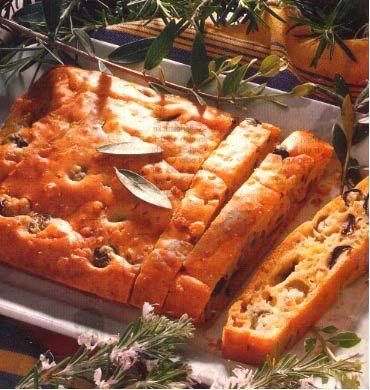 Ingredients:
300g flour
4 small eggs
100 ml olive oil
100 ml white wine
1 tsp baking powder
Salt
100g Greyerzer, Emmentaler or Appenzeller (unsliced)
100g ham or bacon (unsliced)
20 green olives
20 black olives
Oil for greasing the dish
Method:
Mix flour, eggs, olive oil, white wine, baking powder and a bit salt in a bowl, make a smooth dough. Pre-heat the oven to 180°C.
Dice bacon/ham and cheese finely and work under the dough. Stone and half the olives and fold them into the dough as well.
Grease a rectangular baking or soufflé dish lightly with oil, fill in the dough and smooth it with a spoon or spatula. Bake the bread in the middle of the oven about 30 minutes. Turn out on a grid (or leave in the dish). Serve cool.
Mind you, this is so rich that it doesn't just serve its purpose as a "side dish". It's a fairly rich snack by itself.
Champagne Cocktails

I like Champagne Cocktails because they are unfussy to make without any stress of sticking to exact liquid or other measures or the need for elaborate and expensive equipment or tools. Put the money you are saving into the ingredients, because cheap stuff shows -- or rather tastes. Vile, that is. Simplicity is paramount.
Method: Just see that the glasses and ALL the ingredients are very cold. The champagne-ingredients ratio is really up to taste.
Classic: Sugarcube, some drops of Angostura Bitter. This is maybe the only cocktail that requires real champagne or at least so I think. (Lovely pink bubbles! My favourite!) It's for a reason I can not pinpoint, maybe because it's not fruity, an excellent winter drink. Reportedly, this is one of the few original cocktails that appeared in the first (1862) version of the seminal How to Mix Drinks by Jerry Thomas. The recipe has remained unchanged for 150 years.
Campari isn't really, as some claim, an alternative in the "Classic" for Angostura, but still, it makes a fine champagne cocktail variety.
Buck's Fizz/Mimosa: Freshly pressed orange juice to taste. Add gin and peach schnapps and you'll get a Jacuzzi, but the latter is too fussy a recipe for my idea of champagne cocktails.
Kir Royal: With Creme de Cassis. (I think it's overrated.)
Bellini: Fresh peach puree from a very ripe peach. Peach schnapps (not peach liqueur) won't do any harm. Avoid canned fare.
Pear Bellini: Fresh pear puree from a very ripe pear, pear schnapps. (Preferable to the peach variant, or so I think)
Nelson's Blood: With Tawny Port. Brits sometimes take the opportunity to give a toast, which is very apropos.
Black Velvet: With Stout. (Corrupts two perfectly good drinks by mixing them. Yuck!)
Champagne Cooler: Good for using various content of your bar. For example any Brandy or Cognac, or orange flavoured mixers like Curaçao Triple Sec, Cointreau or Grand Marnier.
Elderflower: Add elderflower syrup. Light and pleasant variety!
I realize that die-hard champagne lovers may think all this a sacrilege, and although it is always recommended to use the most expensive ingredients one can afford, I dare saying that the thing that can be first compromised when making champagne cocktails is -- yes -- champagne. A good Italian prosecco or dry German Sekt will do (almost) as well, with the exception of the "classic" champagne cocktail. Oh yes, and always put the mixers in first before the champagne to avoid overflow.
I positively hate those heavy, herbal mixers, such as Chartreuse or anything minty. Besides, I think green looks vile in a drink. And I don't even WANT to know how that awful German liqeur Jägermeister tastes when mixed with Champagne and the same applies to Pernod. If anything, both are something for a down and out party under the bridges.
Raised Pies

Cooking time: as specific recipes
This pastry is made by melting the fat in the water, then adding the flour. It is ideal for cold savory pies. The pastry must be kept warm during rolling and shaping to prevent it breaking. lt is also known as raised pie pastry.
350 g plain flour
1/4 tsp salt
100 g lard or cooking fat
150 ml milk or water
Sift the flour and salt into a mixing bowl. Put the lard or cooking fat into a saucepan with the milk or water and heat until melted. Remove the pan from the heat then add all the flour to the hot mixture, stir well until blended. Allow the dough to cool slightly, so it can be handled, then knead until smooth. Placethe portion required for the base and sides of a pie on a lightly floured board and roll out to desired shape. Keep the rest ofthe pastry, which may be needed for the lid of a pie, in a warm place. Shape and bake as specific recipes.
Variation:
You can add an egg yolk for extra flavour without affecting the amount of liquid.
VEAL AND HAM PIE
Cooking time: 2 1/2 hours • Serves 6
To make the Veal and Ham Pie follow the hot water crust pastry recipe.
For the filling use a total of 900 g veal and ham - this can be equal quantities of each meat or 675 g of veal and 225 g cooked ham. The meats should be diced and mixed together. The method of filling then baking the pie is as given for the Melton Mowbray Pork Pie but omit the anchovy fillets. The stock can be flavoured with a little finely grated lemon zest. It is usual to hard-boil 2 to 4 eggs and put these in the centre of the meat.
When cold, the pie is filled with a jellied stock.
VEAL, HAM AND CHICKEN PIE
Another less usual version of this pie is made by using approximately 675 g thinly sliced uncooked chicken flesh and layering this with the mixture given for Veal and Ham Pie. Bake as the Melton Mowbray Pork Pie.
MELTON MOWBRAY PORK PIE
Cooking time: 2 1/2 hours • Serves 6
This pie it is said to have been invented by a baker in Melton Mowbray, Leicestershire, in 1830. The inclusion of anchovy fillets with pork is unusual but quite good.
625 g lean boneless pork from the leg
225 g fat boneless pork from the belly
6 to 8 anchovy fillets
3 tbspoons white stock
Salt and freshly ground black pepper
Hot water crust pasty from 350 g flour (see above)
1 egg to glaze the pastry
For the jelly:
150 ml white stock
1 teaspoon gelatine
Dice both kinds of pork and blend together. Chop the anchovy fillets and mix with the meat, add the stock. Allow to stand while making the pastry. Season with very little, if any, salt but with pepper. Make the hot water crust pastry as above.
Pre-heat the oven to 160°C/325°F, Gas Mark 3. Lightly grease an 18 cm/7 inch round tin with a loose base or a proper raised pie springform tin, which is usually oval. Roll out two-thirds of the dough (keep the rest warm). Cut a shape to fit the base ofthe tin, and a band the depth and circumference of the sides. Insert the pastry in the tin, moisten and seal the edges. Moisten the top edges of the pastry.
Put in the filling. Roll out the remaining pastry and cut out the lid. Place over the filling and seal the edges. Beat the egg and brush over the pastry.
Traditionally this kind of pie is decorated with pastry leaves and a rose or tassel, so make these from the left-over pastry. Make a slit in the centre of the pastry lid for the steam to escape. Press the leaves and rose or tassel on top of the pie, brush with egg.
Bake for 2 1/2 hours. Lower the heat slightly after 2 hours, if the pastry is becoming too brown. Allow the pie to become quite cold.
Pour the 150 ml stock into a basin, add the gelatine, stand for 2 to 3 minutes then dissolve over hot water. Cool until like a thick syrup. Insert a small funnel into the slit in the pastry lid and pour the jelly through this. Leave the pie in the refrigerator for several hours for the jelly to set, then serve cold with salad.
(I got this from: Marguerite Patten: Classic British Dishes.)
Subscribe to:
Posts (Atom)